selected texts
a space of affection. mostly! a non-exhaustive archive of books, articles, and other writing that are interesting to me (for better or for worse…) click on a cover for thoughts, critiques, and tangents v_v
Otaku: Japan’s Database Animals

what is a database?
when i end up watching deltarune fans create horrible theories because they genuinely find the concept of a terminally ill man faking illness to kidnap people compelling, i think about this book. i picked it up out of an interest in postmodernism, though every time i see this text mentioned online it seems to come with some degree of larp and pseudo-pomo vocabulary. as someone occupationally predisposed to literal databases, the title was interesting, though. having actually read it, i find myself thinking about azuma’s concepts quite a bit.
azuma is interested in what happens to cultural consumption after the decline of the “grand narrative”: the larger systems of meaning that once gave individual lives, experiences, and stories a place within a coherent view of the world. otaku are particularly useful subjects for him because of the strange status that originals and derivatives already have within otaku culture. things like doujinshi and fanwork don’t orbit the original as obviously subordinate copies. sometimes the derivative becomes as desirable as the thing it supposedly derives from, and sometimes attachment to a character or element of a work seems to float almost completely free of the narrative that produced it.
the database is azuma’s attempt to describe what sits underneath all of this. rather than imagining culture as a hierarchy with an original work at the top and increasingly distant copies beneath it, he describes a deep layer composed of settings, character traits, aesthetics, tropes, and “moe-elements.” individual works appear on the surface as particular arrangements of those elements, only to be broken apart again by consumers. a successful new element can be absorbed into the database, copied elsewhere, combined with other elements, and eventually become so conventional that its origin hardly matters. the database isn’t really a fixed catalog so much as a constantly shifting reservoir that producers and consumers are building together.
the original is already a copy
this also gives azuma a more specific account of the simulacrum than “everything is a copy of a copy,” which is about where the usual baudrillard larp online tends to leave it. an original and a derivative can increasingly resemble one another because both are assembled through citation and imitation in the first place. there doesn’t necessarily have to be a pure thing at the beginning of the chain.
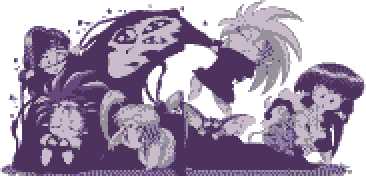
isekai would be the obvious contemporary example here, but that’s kinda easy… so, let’s talk about different low-hanging fruit: tenchi muyo! is generally credited with codifying harem as a sub-genre, but its romance comedy predecessors were already accumulating a vocabulary of recognizable character types, relationships, and situations that later works could endlessly rearrange. the unlucky guy surrounded by women, a combative love interest, an eccentric genius, etc… none of these really belong to any one work, and each becomes increasingly legible through a collection of attributes inherited from characters before them. a new harem heroine doesn’t have to copy any particular predecessor and can instead be assembled from conventions that have already been copied, modified, and returned to the pile so many times that their origins barely matter. each variation adds something else for later works to draw from, until a new character can resemble a hundred earlier characters without really copying any one of them. try finding the original at that point… after enough repetition, the copies have produced something of their own, an accumulated idea that later works can copy in turn. this is what i find compelling about the database: everything that draws from it also has the potential to change what goes back in.
evangelion eating itself
i love tenchi muyo!, but i gotta move on… enough harem!! azuma’s discussion of evangelion is probably my favorite case of the increasingly unstable and confusing relationship between original and derivative. gainax itself emerged from the group behind the gainax, the animation studio that produced evangelion, itself emerged from the group behind the daicon iii/iv opening animations, elaborate fan works assembled out of the anime, manga, science fiction, and other things their creators loved. in other words, gainax was already rummaging through the database long before evangelion started eating itself.
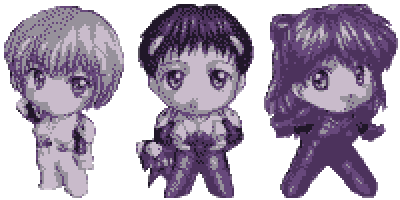
on page 38, azuma points to the alternate universe sequence in the final episode, where rei appears with a completely different personality in an ordinary school setting. according to azuma, this version was already parodying an image of rei that had been circulating in derivative works during the show’s original broadcast. the direction of imitation gets confused in that the derivative imitates the original, only for the original to turn around and imitate the derivative. azuma calls this a case where “the original simulates in advance the simulacra.”
gainax continued playing around with the material after the series ended. in death, material from the series is literally recut into another arrangement, while the end of evangelion gives its ending another form. the rebuild films came well after azuma’s book, but make his choice of example even funnier in retrospect: decades later, hideaki anno, the series’ creator and director, returned to the same characters, relationships, and events and rearranged them all over again. the further this goes, the harder it becomes to imagine evangelion as one authoritative narrative surrounded by secondary objects. it starts looking more like an aggregate of information from which multiple evangelions can be produced.
azuma’s examples of official evangelion merch are really wonderful. azuma lists “mahjong games, erotic telephone card designs using the Evangelion characters, and even simulation games in which players nurture the heroine Ayanami Rei,” and this was in 2001… twenty-five years of licensing later, the list has only gotten endearingly more ridiculous. the range of things that have since become officially licensed merchandise is genuinely difficult to account for… the youtube channel red bard eventually asked the obvious question in Can You Live Entirely Off of Evangelion Merchandise?, and the answer is, incredibly, basically yes…
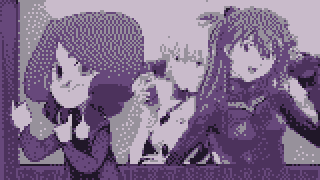
so, evangelion ends up illustrating azuma’s point remarkably well, even as a work often celebrated for being subversive. it draws freely from the cultural database around it, gets pulled apart and fed back into the pile, and eventually starts rearranging its own pieces too. even its characters can be broken down further into elements that move onward into entirely different characters and stories. i’m pretty fond of it, you know… evangelion engorges itself on the broth of its own corpse.
fandom as decomposition
this is where the text becomes difficult for me not to map onto the contemporary internet… fandom has always been skilled at dismantling things. a character becomes a collection of traits, a relationship becomes a dynamic, a narrative convention becomes a searchable tag… a work enters the machine and almost immediately gets decomposed into increasingly granular pieces that can be catalogued, argued over, shipped, theorized about, turned into an AU, and assembled into something else.
sometimes whatever gets assembled from those pieces wanders pretty far from the work they came from. hence the deltarune theorist constructing a psychological drama out of some lines of dialogue, two coincidences, and a recognizable narrative convention. the source material has been reduced to a collection of usable information, and the resulting arrangement can become compelling enough to take on a life of its own. whether any of it was actually intended starts to feel almost beside the point.
the animal part
very importantly, i don’t think azuma’s argument can be reduced to people no longer caring about stories. his database consumer can still cry over a story, become obsessed with a character, or experience one particular narrative as uniquely meaningful while also understanding that its components are interchangeable and that another arrangement waits immediately beside it. sincere attachment and database consumption are not mutually exclusive.
the stranger part is what happens to all that attachment afterward. these “small narratives” can matter intensely without needing to fit together into some greater whole… one can be replaced by another without the postmodern subject having to reconcile the two. the database holds all of these possible arrangements alongside one another, while the consumer is perfectly capable of treating whichever one is in front of them as singular and meaningful.
i’m less convinced when azuma turns this account of cultural consumption into the broader claim of “animalization.” the database is most compelling to me as a description of how media circulates and how people learn to recognize, desire, reproduce, and reorganize its constituent parts. i’m less certain that those habits necessarily tell us everything he wants them to about postmodern subjectivity.
i guess i’ve disagreed with this book plenty while also spending a notable amount of time accidentally reenacting parts of it. i have extremely specific fictional preferences, you know. agghh… the neurons fire as they like!!…
The Moe Manifesto: An Insider’s Look at the Worlds of Manga, Anime, and Gaming

what is moe?
i am a fan of fictional sentiments and attachments. i am a lover of fandom and freaks in the scene. i also pay real money every year to maintain a .moe domain, so reading a book like this was an inevitability. the moe manifesto is a collection of interviews with artists, critics, academics, and various people floating around otaku culture, using moe as an entry point into the question of what it means to become genuinely attached to something fictional.
we do at least need to decide what we’re calling moe here… galbraith decides on an affectionate response to fictional characters, rather than the considerably less useful category of “cute anime girl.” the distinction puts moe in the person experiencing it instead of treating it as some measurable quantity stored inside the girl herself. unfortunately, this creates another problem. if the moe isn’t actually in the centipede bangs, hair vents, deliberate juvenilization, etc… why have people spent decades manufacturing characters out of exactly these things?
the interviewees don’t really agree. this is probably the best thing about the book. depending on who galbraith is talking to, moe is affection, desire, quasi-romantic love, an aesthetic response, a relationship with a character, a response to particular attributes, or a word that has suffered so semantically that it’s basically just approximately synonymous with “cute.” everyone seems to know moe when it happens to them; asking them to explain what happened produces considerably worse results.
constructing the moe homunculus
i think about di gi charat. the moe lab baby…

dejiko has cute kitty traits, bells, enormous eyes, a maid-adjacent outfit, a verbal tic, so on… she ticks an incredible number of moe markers. the resulting critter resembles a moe homunculus assembled from accumulated otaku preference. after otaku: japan’s database animals, it may be tempting for some to look at her and assume that enough preference, arranged correctly, begins to resemble a person.
azuma hiroki of database animals fame returns in the moe manifesto and more or less gives you permission to think this way. his interview revisits the idea of characters as arrangements of elements that can be pulled apart and recombined. bits of one girl can survive her: the hairstyle, the personality, the relationship dynamic, whatever people latched onto. eventually those bits become familiar enough to turn up elsewhere without needing to point back to her at all. moe starts to look almost engineerable, with the history of what people have loved becoming raw material for whatever they’ll love next.
the engineering metaphor falls apart once you ask where the affection actually comes from. soda mitsuru doesn’t think innocence, neotenous proportions, or whatever other attributes are intrinsically moe. they’re things that have happened to provoke moe under particular cultural conditions. he puts much more weight on actually getting to know a character… spending time with her, being given access to her emotional interior, watching her exist in mundane situations… soda’s moe only really emerges through that accumulated familiarity rather than residing neatly in any one of her parts.
in that way, moe is more legible after the fact. once people are already attached to a character, it’s easy enough to work backward and construct an explanation for their appeal. that explanation can then become material for the next character, and the next. a record of what people have loved can very quickly start masquerading as an explanation for just why they loved it in the first place. you can perform the autopsy perfectly well after somebody has already fallen for the girl…
2d love
there is, of course, another very convenient way to explain all of this away: the girl isn’t real…
there’s an easy and extremely boring story you can tell about somebody falling in love with an anime character: he couldn’t get a real girlfriend, so he retreated into animanga and found an agreeable 2d girl who cannot reject him. several of the interviews worry at versions of this explanation, and i think saito tamaki gives the most useful reason to be suspicious of it.
fictional desire is still something people manage to endlessly argue about online, which makes saito’s account feel particularly useful all these years later. he allows fictional desire to exist on its own terms. someone can want something from fiction that they would have absolutely no interest in reproducing in reality. the imaginary maid does not necessarily reveal a suppressed desire to employ an actual woman in a frilly dress. fiction has its own conditions of desire, so trying to translate everything back into a corresponding real-world want may just tell you remarkably little about what someone actually likes.
this feels obvious enough once stated, but people become strangely committed to forgetting it when the attachment is embarrassing or unorthodox. we don’t generally assume that crying over a fictional death means you’ve mistaken the actor for a corpse. desire generally invites a different standard. love or desire directed toward fictional characters and scenarios can suddenly prompt an investigation into whether the afflicted understands that cartoons aren’t real or whether enjoying the wrong fantasy reveals something awful about the person having it. a different interviwee, honda toru, is an unfairly convenient person to bring up here. he is really, truly, very married to kawana misaki … a blind high school senior from the 1998 bishoujo vn one: kagayaku kisetsu e.

and knowing exactly what kind of thing you’ve fallen for doesn’t seem to offer much protection either. honda can call kawana his wife while knowing perfectly well what she is… the fictionality isn’t some embarrassing technicality standing between him and the real woman he would rather have. there is no real kawana underneath the drawing to finally reveal. this makes a funny companion problem to database animals, i think. azuma provides increasingly elaborate ways to dismantle the character until she is lovingly loose parts on the floor. the moe manifesto keeps pointing toward the person kneeling beside the parts, tracing each piece with their fingers.
affection reproduces itself
this is also where my original interest in the book comes back around. i like fandom. specifically, i really like what happens when affection gets so intense that people start doing strange things with it.
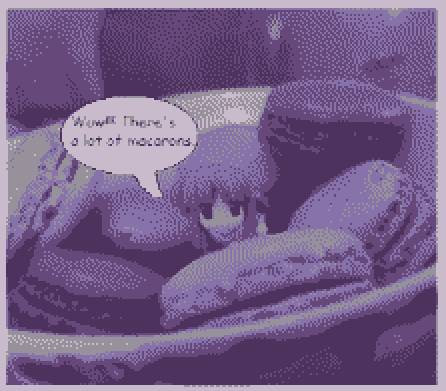
the interviews move through doujinshi, akihabara, character goods… a whole ecosystem built around making, consuming, modifying, and circulating cute girls. whatever moe begins as internally, it doesn’t really remain there for very long. somebody gets attached to a character and draws her. somebody else encounters the drawing and gets attached to that version. somebody buys the figure and takes pictures of it in a bowl of macarons. affection reproduces itself. it’s so cute!!…
part of the charm is that nobody in this book can quite agree on what is even going on. galbraith talks to people embedded in practices that can look completely deranged from the outside and sometimes remain pretty deranged from inside them too, and mostly lets them talk. they often contradict each other. some intellectualize the phenomenon, some seem annoyed by various terminology, and some have concerning theories about society. the interviews never really converge on moe so much as each interviewee shapes it around whatever they’re trying to explain. so whatever moe is, i’m very fond of the crowd gathered around it.
i’m fond of the disagreement too, because some freak behavior always survives the explanation. consumerism, sexuality, loneliness, aesthetics, fantasy, attachment… you can get pretty far with any number of them, and somewhere in the middle of all that, honda toru is still married to kawana misaki.
dot moe
i didn’t finish the book knowing what moe is in any final sense. you’re not supposed to… well, how could you, when everyone in the book seems to be talking about something slightly different? the ambiguity is part of why the word has survived so many attempts to define it.
there is something i find genuinely lovely about giving a name to the stupid little surge of affection a fictional thing can produce. the object can be commercially manufactured, derivative, transparently designed to appeal to you, completely impossible, and entirely humiliating in nature. none of these facts will stop anyone… myself included!
i hope that’s a good justification for the domain name. people love weird things, don’t they? the forms that affection takes are even stranger than its objects. i really am fond of the whole embarrassing apparatus.
Toby Fox’s Secret Base: Volume 5, RPG Maker
please don’t make final fantasy!!
i have a particular affection for hearing artists talk about the things they made before they were particularly good at making things. especially when that artist is toby fox, who has rightfully become a poster child for what a self-taught developer can make (happy birthday undertale!) his fifth secret base article is about the rpg maker games he and his brothers made as kids, most of which were never finished. toby’s adventure, toby’s quest, toby’s adventure 2… they spent years making these, and mostly never finished them.
one of his brothers eventually managed to “finish” something in the form of endless oprah, a game inspired by gundam wing: endless waltz (!!) whose name came from a spelling mistake. fox remembers it as a silly parody that threw in basically anything his brother could think of. an island full of hostile m&ms, an anti-sugar bomb, a pikachu-dictator hybrid… i mourn that this game is unavailable to me… well, eventually, his brother abruptly maxed out the entire party, sent them to the final area, and gave the game an ending.
fox remembers everyone with rpg maker at the time trying to make their own final fantasy, to which he and his brothers weren’t an exception. those are huge games! they were kids!! of course they weren’t finishing these things. endless oprah taught him to work within what he could realistically manage instead. he says he’s approached making games that way ever since, keeping their scope within what he knows he can handle.
ralse gets an i
he also remembers waiting excitedly for new areas of new genesis, the rpg maker game his oldest brother spent years working on. its protagonist was named ralse. this game was never finished, but years later, he added an i and ralsei was born. i really love this detail, so cute… something as small as the name of a default-sprite protagonist managed to follow fox all the way into his own work. you don’t finish the game, whatever!!… you still made it. you’re gonna get something out of it for having even tried.
i’ve only done a little game development myself, but working on a short visual novel for a game jam is enough to make me very sympathetic to any pile of unfinished projects!! even a deliberately tiny game can eat an absurd amount of time and effort. it’s amazing how much work can disappear into five minutes of somebody actually playing the thing. but unfinished or not, i think it’s still worth it… some of it is gonna follow you into whatever you make next!
